Well, I found something when I was searching for which of Edie's costumes I should wear on Friday. It's her obit from North Hampton Star.
Warning: it's a little sad. But enlightening.
http://www.obitpage.com/obits/b/beale_edith.html
Showing posts with label Grey Gardens. Show all posts
Showing posts with label Grey Gardens. Show all posts
Monday, March 19, 2007


Grey Gardens party!
I'm invited to a Grey Gardens birthday party this Friday! Want to come, too? It's in an Atlanta suburb.
You can stay at my place and sleep on the La-Z-Boy.
How can your resist it?
I'll try to remember to bring my camera and will take some photos.
Check out the funny evite my crazy friend Jeffrey (kc met him) wrote.
http://www.evite.com/pages/invite/viewInvite.jsp?event=PMQRBLSMQVLROZFPYNBH&inviteId=ZFCBDDGUIMRERVPTYUTE&showResponse=&sortOrder=&responseToExpand=yes
You can stay at my place and sleep on the La-Z-Boy.
How can your resist it?
I'll try to remember to bring my camera and will take some photos.
Check out the funny evite my crazy friend Jeffrey (kc met him) wrote.
http://www.evite.com/pages/invite/viewInvite.jsp?event=PMQRBLSMQVLROZFPYNBH&inviteId=ZFCBDDGUIMRERVPTYUTE&showResponse=&sortOrder=&responseToExpand=yes
Friday, March 16, 2007
Broad — pun intended — appeal
The subject matter of this film has gone from cult to mainstream. Why do you think the Edies appeal so damn much to people?
Thursday, March 15, 2007
Broadway. Really?
Can you imagine seeing Grey Gardens: The Musical - or whatever it is they're calling it - without having watched this documentary first? I mean, could you really appreciate it?
This song about the best coshtume for the day does not hold a candle to Little Edie's original, revolutionary explanation.
Found this on YouTube:
http://youtube.com/watch?v=JDS8tkdT_-E
This song about the best coshtume for the day does not hold a candle to Little Edie's original, revolutionary explanation.
Found this on YouTube:
http://youtube.com/watch?v=JDS8tkdT_-E
Wednesday, March 14, 2007
Gay Gardens
Being the gay one, or the only gay one speaking — Amy! Hello! Come on, sista! — I have to point this out:
Mommie queerest: three gay men have turned the cult documentary Grey Gardens—about a high-society mother and daughter reduced to living like hermits—into a stage musical.
"Big Edie and Little Edie were honorary gays," exclaims composer Scott Frankel. "They were gutsy, those ladies," says Frankel, who, along with two other gay men — lyricist Michael Korie and playwright Doug Wright — has written a musical based on the film. Frankel recalls being initiated into the Grey Gardens cult by gay friends who could quote lines from the movie verbatim. The film's particular appeal for gay viewers is not hard to explain, he says. It's mostly about Little Edie, with her utterly captivating and idiosyncratic wardrobe and her thwarted ambition to be a dancer. "Even though she experienced tremendous loss and disappointment in her life she was still able to face every day of her life with this huge amount of energy and style," says Frankel, who came up with the idea to turn the film into a stage musical. The Beale women, he adds, "stuck to their fierce individuality their whole lives at great financial and personal cost, and then at the eleventh hour they were celebrated and mythologized. They were rewarded ultimately for their very otherness."
Korie adds, "You can't but admire Little Edie's courage, her staunchness, which is the word she uses. And her sense of fashion almost borders on drag."
"It's a very singular film," Frankel says. "It has so many levels as these women go from these fantastic bons mots and witty quips to a completely self-deluded comment, to a song and a dance, to screaming."
The musical's first act was shaped in part by the writers' discovery that Little Edie had been briefly engaged to John F. Kennedy's brother Joe, who was killed in World War II. "It's such a historical near miss, it's just delicious," Frankel says. In the movie the ladies themselves offer contradictory versions of what precipitated their exile, with accusations flying back and forth between them — exchanges that may have been amplified by the presence of a film crew.
"It just energized them both with a third party present," Frankel speculates.
Mommie queerest: three gay men have turned the cult documentary Grey Gardens—about a high-society mother and daughter reduced to living like hermits—into a stage musical.
"Big Edie and Little Edie were honorary gays," exclaims composer Scott Frankel. "They were gutsy, those ladies," says Frankel, who, along with two other gay men — lyricist Michael Korie and playwright Doug Wright — has written a musical based on the film. Frankel recalls being initiated into the Grey Gardens cult by gay friends who could quote lines from the movie verbatim. The film's particular appeal for gay viewers is not hard to explain, he says. It's mostly about Little Edie, with her utterly captivating and idiosyncratic wardrobe and her thwarted ambition to be a dancer. "Even though she experienced tremendous loss and disappointment in her life she was still able to face every day of her life with this huge amount of energy and style," says Frankel, who came up with the idea to turn the film into a stage musical. The Beale women, he adds, "stuck to their fierce individuality their whole lives at great financial and personal cost, and then at the eleventh hour they were celebrated and mythologized. They were rewarded ultimately for their very otherness."
Korie adds, "You can't but admire Little Edie's courage, her staunchness, which is the word she uses. And her sense of fashion almost borders on drag."
"It's a very singular film," Frankel says. "It has so many levels as these women go from these fantastic bons mots and witty quips to a completely self-deluded comment, to a song and a dance, to screaming."
The musical's first act was shaped in part by the writers' discovery that Little Edie had been briefly engaged to John F. Kennedy's brother Joe, who was killed in World War II. "It's such a historical near miss, it's just delicious," Frankel says. In the movie the ladies themselves offer contradictory versions of what precipitated their exile, with accusations flying back and forth between them — exchanges that may have been amplified by the presence of a film crew.
"It just energized them both with a third party present," Frankel speculates.
The men behind the curtain
Erin mentioned that she liked the moments when the filmmakers talked to the Edies. I did, too, but that got me thinking about the filmmakers' presence in their own film. (Unrelated: I just read that the Maysles wore flea collars around their ankles during the filming). They not only talked to the Edies, but sometimes filmed themselves in mirrors or walking by; often you could see the microphone. What do you think the purpose of this self-inclusion was?
Tuesday, March 13, 2007
Mummy dearest
I had the impression that maybe some bad things happened to Little Edie at home — abuse? neglect? — something that might explain her negative attitude toward her father. And I also had the impression that maybe Big Edie turned a blind eye to some bad stuff (vs. dealing with it) or that she was jealous of her daughter in some way at some point. Did anyone else have that impression?
The persistence of memory
Did you have the impression that the Edies remembered the past more or less correctly?
the story not told
One of the aspects I liked about "Grey Gardens" was that it was not exactly about what I expected. Because of the big-name ties to the Kennedys, I thought there would be more focus on Jackie and Aristotle stepping in to clean up the property, or to dig up dirt on the Kennedys. And the Beales' mental states suggested to me that they could easily have been manipulated into doing the latter. Either there were solid ground rules going in, or these filmmakers showed taste and restraint by leaving the famous family ties in the background. Or, of course, in time spent with the Beales, they recognized they had a better story to tell.
Monday, March 12, 2007
Society women
From an online review:
In 1972, in their January 10th issue, New York magazine published a personal essay by Gail Sheehy recounting her strange encounters with the ladies who lived at Grey Gardens. Events that are only hinted at or briefly mentioned in the film are detailed in Sheehy’s piece. For those of you who wonder why Mrs. Beale described her daughter’s younger days as wild (when it seemed Edie only wanted to be on her own for a while), Edie regales Sheehy with the tale of how she ran away from home three times before Mr. Beale abandoned her mother. And what of that abandonment? Apparently Mrs. Beale was so bored with the strictures of society that she hired an accompanist and started singing in New York nightclubs. This simply wasn’t done, especially by a woman from a prominent family with a husband and children. Instead of reining her in, Mr. Beale threw up his hands and moved out to his hunting lodge. Mrs. Beale’s father was less aloof. After threatening several times to disown her for her bohemian behavior, Major Bouvier finally cut her out of his will after she showed up, outrageously dressed, halfway into her own son’s wedding. Upon Bouvier’s death, she received the sum of $65,000 in a trust fund to be administered by her sons. Needless to say, the money was long gone by the time Sheehy or the Maysles got to Grey Gardens. The tragic fable of the Beale women is this: by turning their backs on society, they paid the price of their freedom by having society turn its back on them.
In 1972, in their January 10th issue, New York magazine published a personal essay by Gail Sheehy recounting her strange encounters with the ladies who lived at Grey Gardens. Events that are only hinted at or briefly mentioned in the film are detailed in Sheehy’s piece. For those of you who wonder why Mrs. Beale described her daughter’s younger days as wild (when it seemed Edie only wanted to be on her own for a while), Edie regales Sheehy with the tale of how she ran away from home three times before Mr. Beale abandoned her mother. And what of that abandonment? Apparently Mrs. Beale was so bored with the strictures of society that she hired an accompanist and started singing in New York nightclubs. This simply wasn’t done, especially by a woman from a prominent family with a husband and children. Instead of reining her in, Mr. Beale threw up his hands and moved out to his hunting lodge. Mrs. Beale’s father was less aloof. After threatening several times to disown her for her bohemian behavior, Major Bouvier finally cut her out of his will after she showed up, outrageously dressed, halfway into her own son’s wedding. Upon Bouvier’s death, she received the sum of $65,000 in a trust fund to be administered by her sons. Needless to say, the money was long gone by the time Sheehy or the Maysles got to Grey Gardens. The tragic fable of the Beale women is this: by turning their backs on society, they paid the price of their freedom by having society turn its back on them.
Where are they now?
After the filming (from imdb.com):
Filmmakers David Maysles and Albert Maysles returned to Grey Gardens and filmed Little Edie talking about what happened after the initial filming; some of this footage appears in "The Beales of Grey Gardens." Edith Bouvier Beale passed away two years after Grey Gardens premiered, in February 1977. Lois Wright, who briefly appears in the film's birthday party scene, moved into the house after the film was made and wrote a book, "My Life at Grey Gardens," about her experiences there, including the death of Big Edie. Many fans wonder if Jerry Torre moved into the house, but according to all accounts other than his own, he did not. Little Edie had a cabaret act at Reno Sweeney in New York City, and, true to Big Edie's predictions, lived in the house for two years after her mother died and then sold it (to Ben Bradlee and Sally Quinn of the Washington Post). Following this, she lived in New York City, Montreal, Oakland, and Florida. She passed away in Bal Harbour, Florida, in 2002.
The New Yorker ran a short article last year about finding Jerry driving a taxi in New York.
Filmmakers David Maysles and Albert Maysles returned to Grey Gardens and filmed Little Edie talking about what happened after the initial filming; some of this footage appears in "The Beales of Grey Gardens." Edith Bouvier Beale passed away two years after Grey Gardens premiered, in February 1977. Lois Wright, who briefly appears in the film's birthday party scene, moved into the house after the film was made and wrote a book, "My Life at Grey Gardens," about her experiences there, including the death of Big Edie. Many fans wonder if Jerry Torre moved into the house, but according to all accounts other than his own, he did not. Little Edie had a cabaret act at Reno Sweeney in New York City, and, true to Big Edie's predictions, lived in the house for two years after her mother died and then sold it (to Ben Bradlee and Sally Quinn of the Washington Post). Following this, she lived in New York City, Montreal, Oakland, and Florida. She passed away in Bal Harbour, Florida, in 2002.
The New Yorker ran a short article last year about finding Jerry driving a taxi in New York.
Crazy ...
Clearly Big Edie and Little Edie were a bit "off." But do you think they were mentally ill?
And in a semi-related question, do you think the film was exploitative?
And in a semi-related question, do you think the film was exploitative?
First reactions
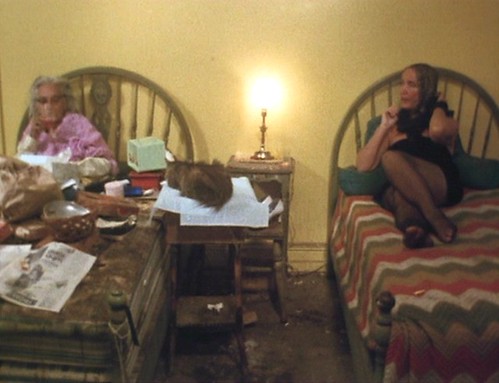
People seem to have greatly varying reactions to "Grey Gardens," finding it disturbing, humorous, sad, fascinating, intrusive. What did you think upon first viewing?
Tuesday, February 27, 2007
For all you STAUNCH characters
 "Grey Gardens" is a 1975 documentary about the everyday lives of Jackie Kennedy Onassis's aunt and cousin in their decrepit 28-room mansion in East Hampton, New York.
The subjects of the film are Edith Bouvier Beale and her daughter (also named Edith -- "Little Edie"). The two women lived together at Grey Gardens for more than 20 years in squalor and almost total isolation. In 1972, their living conditions were exposed in the National Enquirer and a series of raids by the Suffolk County Health Department. Jackie O paid for a cleaning and partial repair job on the house. It was during the restoration that "Grey Gardens" was made.
Hopefully this won't be too difficult for everybody to find. It is available on Netflix.
Subscribe to:
Posts (Atom)