Thursday, January 18, 2007


The Missing War?
Who has read McMurty’s book? Does Duane go off to fight in the Korean War? I was wondering if that scene was added since the timeframe of the movie seems to be a bit off. I wouldn’t have thought that TV would have taken that big a hit on movies by 1952. In particular, would a small poor town have so many sets that people had quit going to their local movie house?
Also, the adults of the town seem to have always been there. But if this is 1951, then many of the men, and some of the women, would have been away during WWII which ended just six years earlier. I didn’t catch a single reference to the War which strikes me as odd for the time. The movie seems like it really ought to have been five or six years later. Then Duane could have gone off in the Army, but not to war.
Also, the adults of the town seem to have always been there. But if this is 1951, then many of the men, and some of the women, would have been away during WWII which ended just six years earlier. I didn’t catch a single reference to the War which strikes me as odd for the time. The movie seems like it really ought to have been five or six years later. Then Duane could have gone off in the Army, but not to war.
King Sam
 Sam's death seemed almost King Lear-like to me. Just as Lear divided his kingdom among his three daughters, Sam divided his properties among Sonny, Genevieve and Miss Mosey. In "King Lear," the division spelled disaster, mainly because Lear's daughters could not get along, which is not the case with Sam's "children" in LPS. In LPS, we see Miss Mosey shut down the theater within a year of inheriting it, saying that if Sam had still been around it would have stayed open (Would it have?). Will the other two properties (the only entertainment in the town) follow suit? Is it Sam's death — and what he stood for — that is really the last picture show, or is the last picture show something more literal having to do, as many suggest, with the romantic demise of cinema and the pedestrian rise of television? (Roger Ebert's review of LPS talks about the role of the moviehouse in American life before TV competition came along, and I think it notes the fact that a TV show is playing in the background of the last scene where Ruth is reading Sonny the Riot Act).
Wednesday, January 17, 2007
Strike the band

If you get the movie on DVD, be sure to watch the documentary with the cast and director. It has a lot of interesting insights into the movie. One of the things Bogdanovich talked about was that he didn't want a soundtrack for the movie. He only wanted music of the era (or earlier) playing in the background on record players or juke boxes or radios (his own voice is one of the DJ's) because he wanted us to hear only what the characters themselves would hear. And I noticed that a couple of the Hank Williams songs played more than once, which added to the realism. And the relative silence also added to what Erin called the quiet desperation of their lives.
What I really liked about that decision is that it didn't rely on music as an emotional prod. It didn't artificially superimpose this layer of mood onto the film. We knew when to be happy or sad or apprehensive; we didn't need music to cue us. I don't know whether he was the first director to eschew music in that way, but I think it was brilliant. It got me thinking critically about how music works in other movies.
Tuesday, January 16, 2007
Women past the verge of a nervous breakdown
 Another thing that really struck me about this movie, especially given when it was released (1971), is the director's treatment of the women's lives, which I thought was unusually sensitive. Each of the three older women had some cross to bear and did so with a certain dignity, even if that meant bucking the "morality" of the time. Each had been fully disillusioned. Each was extremely nurturing in her own way. And moreover, the director made sure that we knew that they all liked and respected one another (which impressed me as a sort of nod to the "sisterhood is powerful" sentiment of the women's movement of the early '70s).
Do you think Jacy was made in their mold, or is she fundamentally different? All three of them, including her own mother, badmouth her at various points ...
Bad sex
I found the sex in LPS pretty damn dreary. Every scene was a failure in some way, beginning with Sonny's listless makeout session in the truck. Then there are Jacy's various sexual manipulations throughout the movie; Billy's pitiful experience with the town whore; the mention of substituting a cow for a woman; the depressingly mechanical missionary scenes with Duane, Abilene and Sonny; Duane's failure to perform followed by his failure to please; the repressed coach whose sexuality works itself out in ass slaps and dirty pep talk; the preacher's pedophile son; the swinging teens in Wichita Falls for whom sex is a game of truth or dare.
The only good sex, apparently, is betwen Lois and Sam the Lion, who frolicked with glee at the fishing tank (compare their naked swimming in the great outdoors to that of the rich kids in the swanky indoor pool). And, although it's not shown, I think we are led to believe that Sonny and Ruth moved beyond the disappointment of their first encounter to something more fulfilling for both of them (I think in that one scene where she is brushing his hair and the bed is neatly made that we are supposed to assume that they had just made love wildly on the floor).
What did you make of the dreary sex? Was it a commentary on the small town? On all the ills of 1950s America: conservatism, false morality (Jacy tells her mom that premarital sex is a sin and her mom laughs in her face), sexism?
Character development
One feature of the film that really struck me is how most of the characters became disillusioned at some point pretty soon after beginning their adult lives and how they dealt with their discontent. Lois was already cheating on her husband in her early 20s, looking for the adventure she longed for that she already knew she wasn't going to get from her marriage. Genevieve and her husband ran around with Lois and her husband when they were young — they were all equals, but then by dumb luck Lois' husband struck it rich and Genevieve's husband didn't. They just became mired in debt and Genevieve had only a life of waitressing to look forward to. Ruth's dream of marrying the manly coach (partly because her mom hated him) turned rapidly into a nightmare. Sam's wife went crazy and the love of his life belonged to someone else. The coach was clearly a homosexual and stuck in a life that was completely wrong for him. The next generation, in the year during which the film takes place, rapidly began to see the disparities in how life after high school was vs. how they thought it would be: Jacy discovered the disappointments of love and sex, after having "saved" herself for so long — and, without the dramatic backdrop of high school, she discovered that she had to invent her own drama; Duane figured out that loving someone doesn't automatically make them love you back, the persistence of a broken heart, the limitations that social class would put on his life; Sonny figured out the lessons of responsibility and the obligations and rewards of love and how to cope with loss.
For a town where supposedly nothing ever happens, there sure is a lot going on. Did the depth and pacing of character development feel more or less natural to you, or did it seem contrived in ways?
For a town where supposedly nothing ever happens, there sure is a lot going on. Did the depth and pacing of character development feel more or less natural to you, or did it seem contrived in ways?
Black and white
In a special feature on the DVD of "Last Picture Show," director Peter Bogdanovich says he made the movie in black and white at the suggestion of Orson Welles — mainly to get greater depth of field. As I was watching the movie, I found it almost impossible to imagine it in color, because of the time period and the setting, which Lois herself described to her daughter as being "so flat and empty."
And yet I've seen other movies involving bleak landscapes and content that were successful in color.
What did you think? Could color have worked? Would it really have changed the film in an important way?
("Sunset Boulevard" could have been shot in color, couldn't it have?)
And yet I've seen other movies involving bleak landscapes and content that were successful in color.
What did you think? Could color have worked? Would it really have changed the film in an important way?
("Sunset Boulevard" could have been shot in color, couldn't it have?)

Thursday, January 11, 2007
Reminder
We'll start discussing LPS on Monday, Jan. 15. And the next person in line will pick a new movie the same day. The order right now is Noir Muse, SH, Ben, CL, Driftwood, Erin, George, then me again.
Saturday, January 06, 2007
"Sunset" narration
I only watched the first 20 minutes of "Sunset Boulevard" before I was getting ready to go to Kim's, then finished it later. But in that first 20 minutes I was taken with the clever narration, from the great lines (the one about copy editors won me over, of course) to how effectively the storyline was set up to how it could keep the movie at a brisk pace.
There was a major break in that style during the extended time when Norma, Joe and Max visit the studio, and we're allowed to perceive exactly what the studio bigwigs thought and said about Norma without Joe's omnipresent perspective. It was an abrupt change to me, and I thought there could have been a couple of reasons for it -- that the audience, who may have found Norma pathetic, would see how well-respected she'd been back in the day as opposed to being exposed for a nobody. Or that she wasn't so pathetic -- that Joe's perception of her influenced what the viewer saw. Or maybe Joe's voice worked most effectively in that claustrophobic coccoon of a house.
There was a major break in that style during the extended time when Norma, Joe and Max visit the studio, and we're allowed to perceive exactly what the studio bigwigs thought and said about Norma without Joe's omnipresent perspective. It was an abrupt change to me, and I thought there could have been a couple of reasons for it -- that the audience, who may have found Norma pathetic, would see how well-respected she'd been back in the day as opposed to being exposed for a nobody. Or that she wasn't so pathetic -- that Joe's perception of her influenced what the viewer saw. Or maybe Joe's voice worked most effectively in that claustrophobic coccoon of a house.
Thursday, January 04, 2007
Remember this?
 The whippersnappers probably have never seen the "Sunset Boulevard" spoofs on "The Carol Burnett Show." It was a regular skit — and not one that I really understood or found amusing as a kid, except for her great physical comedy, although I'd find it hilarious now. We should try to dig up some of those shows.
Joe mama!
It's one thing for Joe to resent being a kept man and to start quietly looking for a way out, but it's quite another for him to boldly insult his sugar mama, to, like a merciless predator, zero in on her weakness — her vanity — and rip her to shreds. It seems like a smarter, more compassionate man might contrive a plausible excuse to get out of the house and simply not return, instead of making a big production out of his "honor" and "the truth" by telling her — unstable as she is!— that she's a has-been, that Max is responsible for the fan letters, that no one will care if she commits suicide ("Oh, wake up, Norma, you'd be killing yourself to an empty house. The audience left twenty years ago.")
He's smart enough to realize this:
Joe Gillis (as narrator): You don't yell at a sleepwalker. He may fall and break his neck.
Or he may shoot you dead with the gun he just showed you, you Goddamn idiot!
So my question to you, notwithstanding my feelings on the matter, is this: Is Joe a Goddamn idiot? For undersestimating Nora's capacity to do something truly dire, to think she would take his hubris sitting down? Of course, the film could not have had its justly famous ending if Joe hadn't provoked her in some way. Did he ultimately do her a favor by shattering her way of life, even if she's not really aware that it's been shattered?
Wednesday, January 03, 2007
Joe's deadline

Joe decides at the end to go back to Dayton, Ohio, to return to the copy desk, a decision that leads to his untimely death. Proof that all of us former copy editors should never stray back? And what does this mean for our lone member still working on the night desk?
Max, darling
 I think a case could be made that Max is the real hero of this film. He is fully devoted to Nora's illusion — some might say he's an enabler — but he seems to truly love her and care for her, without appearing to get much in return besides room and board. He helps the woman he loves snare another man. He can't enjoy that, but he does it because she wants it, and her happiness is more important to him than his own. Nora's looking after No. 1, for the most part, and so is Joe, but Max isn't. Or is he?
Tuesday, January 02, 2007
Timeless classic, or ready for an update?
Every now and then there is talk of remaking "Sunset Boulevard." Heck, even Gloria Swanson wanted to do a musical theater version, but with Norma becoming a mother figure, blessing Joe and Betty's relationship in a happy ending (the studio blocked this, wanting to preserve the story). Do you think "Sunset Boulevard is due for an update because it would be better told with stars who are more recognizable, or do you think the story stands as is?
Sympathy for the Devil
Gloria Swanson had an illustrious career as a silent film star, but it's her portrayal of Norma Desmond that she's been remembered. Did you have sympathy for Norma, or did you just think she was a loon?
Inside Hollywood
"Sunset Boulevard" gave a pretty good depiction of the state of Hollywood at the beginning of the '50s. The studio system was in decline, so the big studios weren't producing B movies anymore, which is why Joe couldn't find work. The casting of the film also involved bringing on stars from the silent era who were very similar to the characters they played. To me it really adds to the experience of watching the film, but I knew all of the inside information because I studied the movie in school. I know a lot of you read up on the film after watching it, do you think you have to know all that information beforehand to really appreciate "Sunset Boulevard"? I know I liked "The Player" when I first saw it when it came out, but I didn't realize just how good it was until I was a film student. What to all of you think?
Joe Schmoe
One of the arguements about "Sunset Boulevard" is whether it is a true "noir" film. The defining element of film noir, according to scholars, is how the main character has been chosen by fate for no particular reason to have bad things happen to them. What do you all think? Was Joe Gillis a victim of fate, or was he done in by his own choices? And did he make a good hero, or did he deserve his fate?
Monday, January 01, 2007
Kim's pick
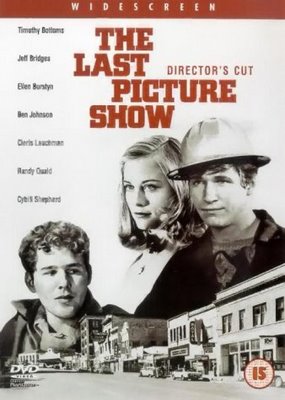
I considered choosing this film before George chose "Sunset Boulevard," which I had never seen. Now that I've watched "Boulevard" — a film about the end of a way of life — this movie seems especially topical:

Subscribe to:
Posts (Atom)